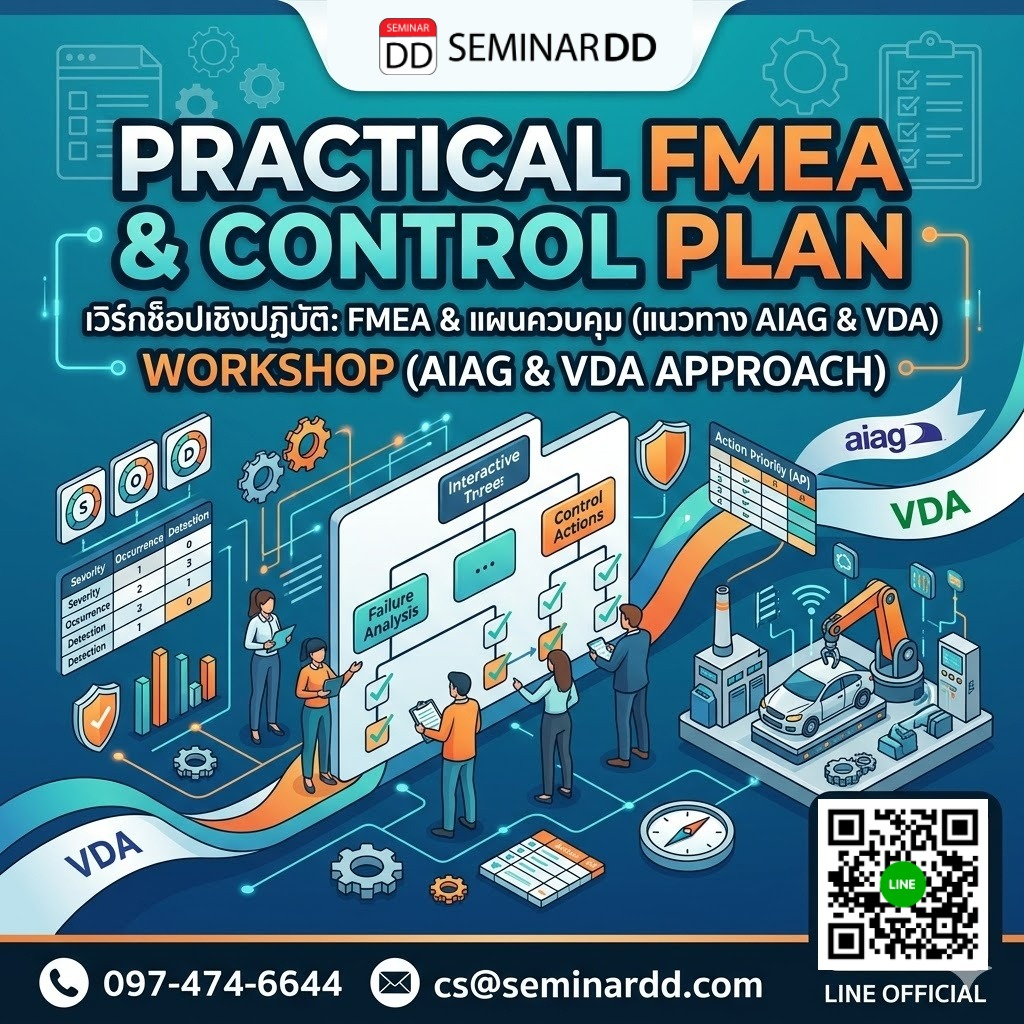
หลักสูตรฝึกอบรม Practical FMEA & Control Plan Workshop (AIAG & VDA Approach) หลักสูตร 1 วัน
รหัสหลักสูตร: 68891
-
ยังไม่มีรอบจัดในขณะนี้
ท่านสามารถลงทะเบียนล่วงหน้าเพื่อรับการแจ้งเตือนเมื่อมีรอบใหม่
In today’s highly competitive automotive and manufacturing industries, organizations must ensure that product and process risks are systematically identified and controlled before they impact product quality, safety, and customer satisfaction. Failure Mode and Effects Analysis (FMEA) is widely recognized as one of the most important preventive quality tools within the Advanced Product Quality Planning (APQP) framework. It enables organizations to proactively analyze potential failure modes, understand their effects and causes, and implement preventive actions to reduce risks in manufacturing processes.
However, many organizations still face challenges when applying FMEA effectively. In many cases, FMEA is created merely as a document for audit or customer requirements, without being fully integrated into actual manufacturing processes. As a result, the linkage between Process Flow, FMEA, and Control Plan is often unclear, and high-risk items identified in FMEA are not properly translated into practical process controls. This leads to ineffective risk prevention and missed opportunities for process improvement.
To improve the effectiveness and consistency of FMEA implementation, the Automotive Industry Action Group (AIAG) and the German Association of the Automotive Industry (VDA) jointly introduced the AIAG & VDA FMEA Handbook, which provides a structured 7-Step Approach for performing FMEA. This modern methodology emphasizes systematic analysis, cross-functional collaboration, and the use of Action Priority (AP) to better prioritize risk reduction actions.
The Practical FMEA & Control Plan Workshop (AIAG & VDA Approach) is designed as an intensive and practical training program that enables participants to understand and apply the AIAG–VDA FMEA methodology effectively in real manufacturing environments. Through lectures, case studies, and hands-on workshops, participants will learn how to perform Process FMEA step by step, evaluate risks using the Action Priority concept, and translate FMEA results into an effective Control Plan. The program focuses on practical application to ensure that participants can implement FMEA as a proactive risk management tool that strengthens process control, improves product quality, and supports continuous improvement in their organizations.
Training Objectives
1. To provide participants with a clear understanding of FMEA methodology and its role in risk management within the APQP framework.
2. To develop participants’ capability to systematically identify potential failure modes, effects, and causes in manufacturing processes.
3. To enable participants to analyze and evaluate process risks using the AIAG–VDA FMEA methodology, including Severity, Occurrence, Detection, and Action Priority (AP).
4. To strengthen participants’ ability to develop effective improvement and risk reduction actions based on FMEA analysis.
5. To equip participants with practical skills to develop and implement Control Plans that are properly linked to FMEA results.
6. To enable participants to apply FMEA and Control Plan tools effectively in real production processes to improve quality and reduce operational risks.
Opening class to explanation the training purpose,
• Pre-Test (ทดสอบก่อนอบรม)
FMEA Methodology
1. Introduction to Risk Management in Automotive
• Role of FMEA in APQP
• Relationship between (Process Flow & FMEA & Control Plan)
• Common FMEA mistakes in industry
2. Overview of AIAG & VDA FMEA
• Why FMEA changed from AIAG to AIAG-VDA
• Key differences from traditional FMEA
• Introduction to 7-Step Approach
3. FMEA Step 1 – Planning & Preparation
• Define scope, Build cross-functional team, Define boundaries
4. FMEA Step 2 – Structure Analysis
• Product / Process Structure, Process Flow Diagram, Process breakdown
5. FMEA Step 3 – Function Analysis
• Function of process, Requirements, Failure logic
6. FMEA Step 4 – Failure Analysis
• Failure Mode, Failure Effect, Failure Cause
7. FMEA Step 5 – Risk Analysis
• Severity/ Occurrence/ Detection/ Explain Action Priority (AP) concept
8. FMEA Step 6 – Optimization
• Define improvement actions, Risk reduction strategies
9. FMEA Step 7 – Documentation
• FMEA report, Update and maintenance, Link to lessons learned
10. Workshop
Control Plan
1. Control Plan Concept
• Purpose of Control Plan & Relationship
• Types of Control Plan (Prototype, Pre-launch, Safe launch, Production)
2. Control Plan Element
• Process Step, Product Characteristices, Process characteristics, Control method and frequency
• Reaction Plan and Responsible
3. Linkage Between FMEA & Control Plan
• How high-risk items in FMEA become controls in Control Plan
4. Practical Case Study (Workshop) - Participants work in groups, activity
• Create Process Flow
• Build Process FMEA
• Evaluate Risk
• Develop Control Plan
5. Common Problems in FMEA & Control Plan
• FMEA done only for documents
• Control Plan not linked with real process
• Reaction plan not defined
• Verify effectiveness of control plan
ทบทวนและสรุปก่อนจบหลักสูตร Review overall training in Day one.
• Key Takeaways & Key Clauses
• Q&A
• Post Test

 ไทย
ไทย สัมมนานี้ได้รับประกาศนียบัตร
| ชื่อหน่วยงาน/บริษัท: | SeminarDD Academy |
| ชื่อผู้ประสานงาน: | ผู้จัดงาน |
| เบอร์โทรศัพท์ : | 097-474-6644 |
หากท่านต้องการสมัคร Practical FMEA & Control Plan Workshop (AIAG & VDA Approach)
กรุณากดปุ่ม 'สมัครเข้าฟัง' ด้านล่างนี้
(ถ้ามีจัด ท่านจะได้สิทธิ์ก่อน)
หลักสูตรนี้สามารถจัดแบบ In-House Training (สอนเฉพาะองค์กรของคุณ) ได้ทั้งแบบ Onsite และ Online ขอใบเสนอราคา In-house Training
 Tags: FMEA, Control Plan Workshop, Control Plan, AIAG, VDA
แจ้งสัมมนาไม่เหมาะสม
จองสัมมนารอบต่อไป